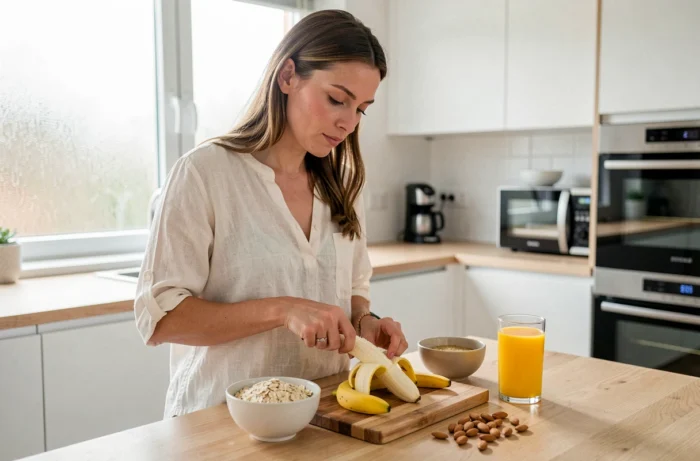
The banana has a remarkable nutritional density for a fresh fruit: potassium, magnesium, vitamin B6, fiber. The problem does not lie with the fruit itself, but with how it is consumed at breakfast. Eating a banana alone on an empty stomach, especially if it is very ripe, significantly alters the glycemic response. We observe that most nutritional warnings actually target a specific scenario, not an intrinsic property of the banana.
Resistant starch and ripeness: the parameter that glycemia does not forgive
The stage of ripeness radically transforms the carbohydrate composition of the banana. A green banana contains a high proportion of resistant starch, a carbohydrate that the small intestine does not digest and behaves like soluble fiber. Its glycemic index remains low.
As the banana ripens, this starch converts into simple sugars (glucose, fructose, sucrose). A very ripe banana, with a heavily speckled skin, has a significantly higher glycemic index. The glycemic load shifts from a low level to a moderate or even high level depending on the size of the fruit.
In practical terms, choosing a banana that is still slightly firm (yellow skin without brown spots) rather than a very ripe banana is enough to alter the kinetics of glucose absorption. To understand the reasons to avoid the banana at breakfast in its very ripe and isolated version, one must think in terms of ripeness rather than labeling the fruit as “good” or “bad”.
A green banana and a speckled banana are not the same food metabolically. Popular articles often overlook this distinction, which fuels confusion.
Banana on an empty stomach and glycemic spike: what really happens
On an empty stomach, the body has no digestive buffer. Consuming a food high in simple sugars without accompaniment (proteins, fats, complementary fibers) causes a rapid rise in blood sugar followed by a reactive drop. This phenomenon is not unique to the banana: it applies to any sweet fruit eaten alone in the morning.
The ripe banana combines two unfavorable characteristics in this context: a significant content of simple sugars and a low content of fats and proteins. The result is a glycemic spike followed by reactive hypoglycemia within two hours, accompanied by feelings of hunger, fatigue, and difficulty concentrating.
Profiles primarily affected
Diabetic or pre-diabetic individuals exhibit an increased sensitivity to this morning glycemic response. Fasting hyperglycemia, common in these profiles, amplifies the effect of an unbalanced carbohydrate intake.
In an adult without metabolic disorders, the impact remains moderate if the banana is included in a complete meal. We recommend not to dramatize occasional consumption but to systematically pair the banana with other macronutrients at breakfast.
Breakfast composition: correctly pairing the banana
The real lever is not to eliminate the banana, but to never consume it alone. The combination of proteins, fats, and fibers slows down sugar absorption and transforms the glycemic response.
The combinations that work metabolically:
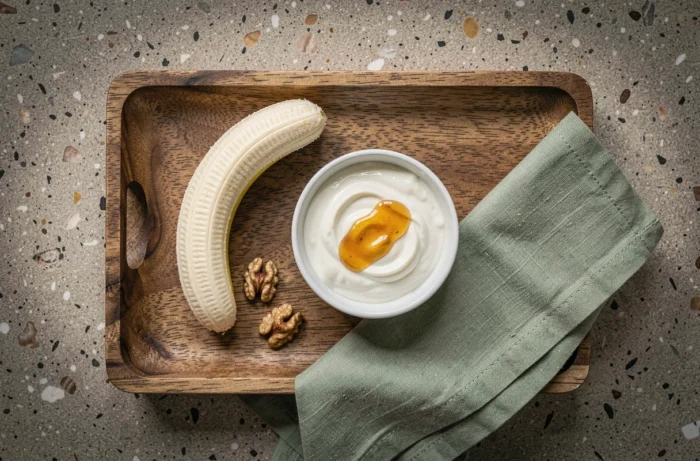
- Banana (preferably slightly unripe) with a source of protein such as cottage cheese, eggs, or unsweetened plain yogurt, which provide a direct digestive buffer
- Sliced banana on whole grain oatmeal, whose beta-glucans slow gastric emptying and smooth the glycemic curve
- Banana paired with a handful of nuts (almonds, walnuts) that add fats and fibers, reducing the speed of glucose assimilation
In these configurations, the overall glycemic load of the meal decreases significantly. The banana then provides its micronutrients (potassium, magnesium, vitamin B6) without the metabolic drawbacks of isolated carbohydrate intake.
The morning banana smoothie trap
Blending a banana destroys part of the fruit’s fibrous matrix. The sugar becomes even more bioavailable, and the absorption speed increases. A banana-orange juice-honey smoothie, common in breakfast recipes, combines liquid simple sugars with a lack of proteins. A banana smoothie without added protein behaves like a sweet beverage in terms of glycemia.
Adding peanut butter, chia seeds, or cottage cheese to the smoothie significantly alters this profile. The texture changes, but the metabolic response does too.

Banana and time of day: is morning the worst choice?
Morning is not the most unfavorable time to consume a banana if it is well paired. In the afternoon or evening, the banana presents an interesting profile: its contribution of tryptophan (precursor to serotonin and then melatonin) and magnesium can promote muscle relaxation and sleep quality.
As a sports snack, the ripe banana regains an advantage: its quickly available sugars replenish glycogen stores after exercise. The metabolic context changes everything. The same fruit can be relevant or counterproductive depending on the time and the goal.
For individuals prone to fasting hyperglycemia, delaying banana consumption to midday, after a meal containing proteins, remains the simplest and most documented strategy.
The banana does not deserve its status as a morning superfood nor that of a fruit to be banned from breakfast. Choosing a fruit at moderate ripeness, pairing it with proteins and fats, and avoiding consuming it alone on an empty stomach: these three parameters are sufficient to reap the nutritional benefits without experiencing the glycemic spike. The pertinent question has never been “should we eat a banana in the morning?”, but “under what conditions?”.