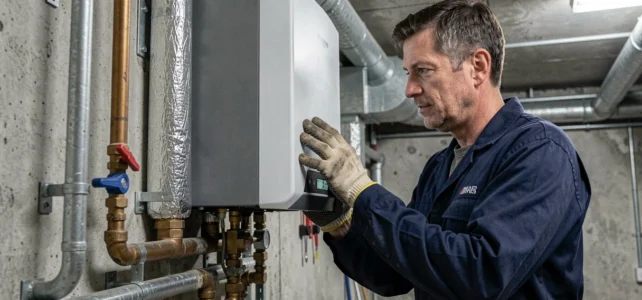
Replacing a traditional boiler with a condensing model in a collective building raises issues that are not encountered in individual homes. The evacuation of acidic fumes, the management of condensates, and the recent regulatory framework profoundly alter the technical and financial equation of these co-ownership projects.
Collective shunt ducts: the technical lock of old buildings
Most buildings constructed between the 1960s and 1980s use collective shunt ducts. These ducts, designed for atmospheric boilers, rely on natural draft and materials that do not withstand the acidic condensates produced by a condensing boiler.
A co-owner cannot simply replace their boiler without intervening on the entire column. Shunt ducts are not compatible with a conversion on a unit-by-unit basis. The co-ownership must address the entire riser, either through full lining with polypropylene or stainless steel tubing, or by switching to a flue system with an exterior exit.
Lining a complete column requires the agreement of the general assembly, as the duct is a common part. The work affects all connected apartments, even those whose occupants do not wish to change their equipment. This point regularly generates blockages in assembly meetings. The constraints related to the installation of a condensing boiler in a building therefore far exceed the scope of individual housing.
Evacuation of condensates in co-ownership: often underestimated constraints
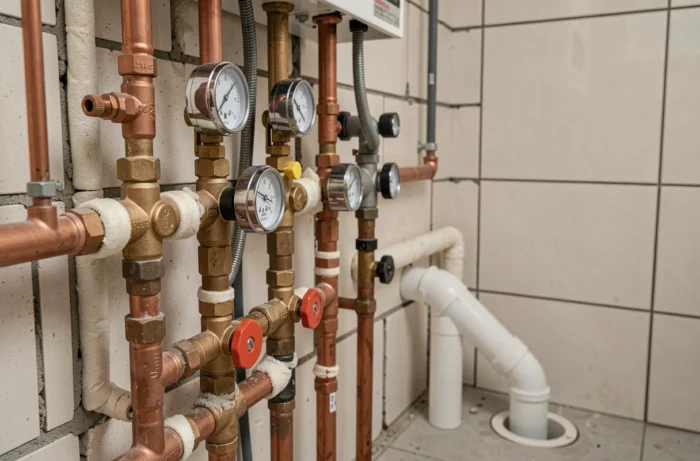
A condensing boiler produces several liters of condensate per day. This liquid, which has an acidic pH, must be evacuated to the wastewater network. In individual homes, the connection is direct. In buildings, the situation becomes more complicated.
The collective drainage network is not always accessible from the boiler’s location. In apartments located on upper floors, it is necessary to check for the presence of a nearby wastewater downpipe, ensure a sufficient slope for the drainage pipe, and in some cases, install a condensate neutralizer to protect the common pipes.
- The condensate neutralizer, mandatory in certain configurations, contains limestone granules that raise the pH of the liquid before discharge. It requires regular maintenance (replacement of granules).
- The minimum slope of the drainage pipe must be maintained along the entire length of the run, which may require drilling or routing through a false ceiling.
- The connection to the wastewater network (and not to rainwater) is a regulatory obligation that the plumber must verify before any commissioning.
In practice, field reports vary on the ease of these connections. In Haussmannian buildings or residences from the 1970s, the technical shafts are sometimes too narrow to accommodate an additional duct.
20% VAT and end of subsidies: the financial equation has changed
The economic framework for gas condensing boilers has shifted. The VAT on the installation of a gas boiler was raised to 20% on March 1, 2025, eliminating the reduced rate that these equipment benefited from under energy renovation.
At the same time, MaPrimeRénov’ Copropriété no longer finances any fossil solutions. A co-ownership that undertakes a collective replacement of individual boilers with gas condensing models can no longer mobilize this public lever. Energy savings certificates (CEE) remain theoretically accessible, but their unit amount makes the remaining costs significant.
This double evolution is prompting some co-ownerships to reconsider the relevance of gas condensing systems in the face of collective heat pumps or hybrid systems. The available data does not yet allow for measuring the real impact on the volume of installations in buildings, but the trend towards a slowdown is visible among specialized installers.
Quick comparison of financial levers
| Criterion | Gas condensing boiler | Collective heat pump |
|---|---|---|
| Applicable VAT | 20% | 5.5% |
| MaPrimeRénov’ Copropriété | Not eligible | Eligible |
| CEE | Limited amount | Higher amount |
Ventilation and air supply for the boiler room: a standard often poorly applied
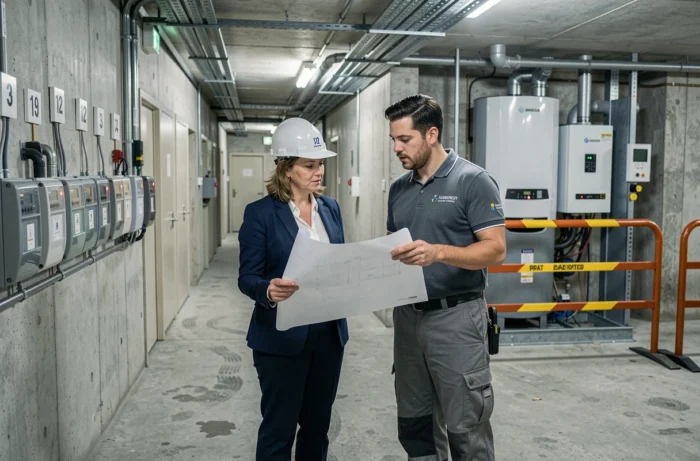
A chimney-type condensing boiler (natural draft) requires a permanent air supply in the room where it is installed. In an apartment, this constraint translates into a non-blockable low ventilation grille, sized according to the power of the device.
Sealed models, which draw air directly from outside, do not impose this permanent ventilation. This is why the flue has become the dominant configuration in collective buildings. The concentric duct (incoming air / outgoing fumes) passes through the façade or connects to a terminal on the roof.
Switching to a flue system is not trivial from an architectural standpoint. Each terminal on the façade alters the exterior appearance of the building, which may require authorization from the co-ownership, or even an opinion from the Architects of the Buildings of France in protected areas. Co-ownerships located in historic city centers regularly face this type of refusal.
Condensing boiler in a collective building: what really blocks projects
The technical difficulties (ducts, condensates, ventilation) are documented. However, the most frequent blocking factor remains the governance of the co-ownership. A vote by absolute majority is required for work on common areas, and the coordination between co-owners, the property manager, and the installer extends the timelines by several months.
The overall cost of a collective project far exceeds the price of the boiler itself. Lining the duct, neutralizer, drilling, bringing ventilation into compliance, fees for the thermal study office: each item adds up. Without significant public aid, the return on investment extends compared to what manufacturers’ product sheets promise.
The market is now steering co-ownerships towards decarbonized solutions. The gas condensing boiler remains technically efficient (up to 30% savings compared to an old generation boiler, according to GRDF), but its regulatory and financial framework tightens each year. Co-ownerships still considering this option should have a technical audit of the drainage network conducted before any decision in the general assembly.