
A patient goes home the same day after a laparoscopic salpingectomy, convinced that the small incisions mean a quick recovery. Three days later, she is carrying a moving box and triggers abdominal pain that brings her back to the emergency room.
This common scenario illustrates a gap between the minimal appearance of the procedure and the reality of recovery after salpingectomy. The fallopian tubes are removed from a deep space in the pelvis, and internal healing takes longer than what the skin scars suggest.
Opportunistic or isolated salpingectomy: recovery is not managed the same way
This distinction is rarely discussed in public content, yet it changes everything for recovery. When salpingectomy is performed during another pelvic surgery (hysterectomy, surgery for endometriosis), the recovery follows the rhythm of the main procedure, not that of the removal of the tubes themselves.
Specifically, a patient undergoing a hysterectomy with opportunistic salpingectomy must adhere to the post-operative instructions for the hysterectomy, which are often longer and stricter. The mistake is to underestimate the rest period by thinking that “removing the tubes is no big deal.” The surgeon tailors their recommendations to the main surgery, and that timeline is what matters.
In contrast, an isolated laparoscopic salpingectomy (voluntary sterilization, ectopic pregnancy) allows for a quicker resumption. The nuance regarding recovery after salpingectomy and tube removal should be established as early as the pre-operative consultation with the gynecologist, to calibrate the work stoppage and activity restrictions at the right level.

Mobilization and post-operative pain: the ERAS protocol applied to salpingectomy
ERAS protocols (Enhanced Recovery After Surgery), now widespread in pelvic surgery, have changed the traditional recovery guidelines. One no longer stays lying down for several days waiting for the pain to pass. The central principle is very early mobilization, ideally within the first hours following awakening.
Getting up early does not mean doing everything
Walking slowly in the hospital corridor on the day of the procedure promotes intestinal transit and reduces the risk of venous thrombosis. This is a gesture validated by current surgical recommendations.
The common mistake is to confuse this gentle mobilization with a normal return to activities. Lifting heavy loads, doing intensive cleaning, or resuming sports in the first week remains contraindicated.
Managing pain without falling into opioid excess
Multimodal analgesia is another pillar of the ERAS protocol. Several types of pain relievers (paracetamol, anti-inflammatories) are combined to minimize the use of opioids, which cause constipation, drowsiness, and slow down the resumption of transit.
If the pain remains manageable with level 1 analgesics, that’s great. If it increases instead of decreasing after the first few days, it’s a signal to communicate to the surgeon, not a reason to double the doses on your own.
Concrete mistakes that delay healing after tube removal
Some patients follow general guidelines but make specific mistakes that usual content does not detail. Here are the most common in practice.
- Taking a bath or swimming before the end of healing. Showering is possible as soon as the primary dressing is removed, the day after surgery, but prolonged immersion in water should be avoided until the incisions are completely closed.
- Removing Steri-Strips too early. These small adhesive dressings placed directly on the incisions should remain in place for the time indicated by the surgeon. If they fall off in the shower, there’s no need to replace them, but pulling them off out of impatience exposes the scar to improper closure.
- Resuming driving too quickly. One should not drive during the week following the operation, nor while taking painkillers that impair alertness. Sudden braking puts stress on the abdominal muscles and internal sutures.
- Neglecting hydration and fiber. Post-operative bloating and constipation are almost systematic after a laparoscopy (the gas inflated in the abdomen takes several days to dissipate). Increasing fluids and fiber as soon as returning home limits this discomfort.
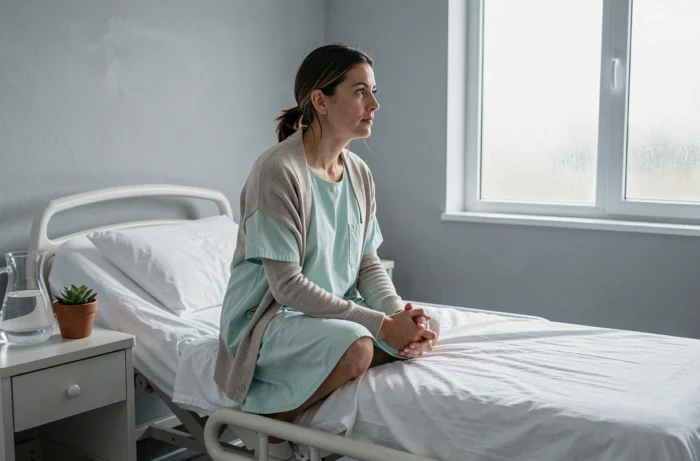
When to seek emergency care after a salpingectomy
The line between normal pain and complications is not always clear, and feedback varies on this point among patients. However, certain signals can justify a call to the surgeon or a quick consultation:
- Persistent fever beyond the first few post-operative hours.
- Redness, warmth, or abnormal discharge around the incisions, which may indicate an infection.
- Abdominal pain that worsens instead of gradually decreasing, especially if it is concentrated on one side of the pelvis.
- Heavy or unusual vaginal bleeding not reported as normal by the surgical team.
These warning signs are not always detailed on discharge papers. It is beneficial to ask the surgeon directly before leaving the hospital: “At what level of pain or what symptom should I call back?” This simple question helps avoid unnecessary consultations and delays in the face of a real complication.
Resuming activities after laparoscopy: a realistic timeline
Resumption varies depending on the type of work and lifestyle. For a sedentary job, return generally occurs within two weeks. Physical work or impact sports require a longer delay, under medical supervision.
The gynecologist specifies during the post-operative follow-up visit when various activities can resume, including sexual intercourse, depending on internal healing.
Visible healing (the small skin incisions) gives a false impression of complete recovery. The repair of internal tissues continues for several weeks. Adapting one’s pace to this reality, rather than to the appearance of the scars, remains the best way not to compromise recovery after a salpingectomy.