
The number of households purchasing protein powders has doubled in two years in France, driven by Generation Z and Millennials. This expanded audience, less familiar with the codes of sports nutrition, faces dozens of references on shelves or online. Choosing a protein powder for muscle gain requires comparing specific parameters: type of protein, absorption rate, amino acid profile, and manufacturing quality.
Amino Acid Profile and Leucine: Indicators Not Highlighted by Marketing
Most guides compare whey, casein, and plant proteins by their origin. This approach masks the most determining criterion for muscle gain: the amino acid profile, particularly the leucine content.
Leucine is the amino acid that triggers muscle protein synthesis. A powder can display a high protein content while remaining low in leucine, which directly limits its effectiveness for building muscle.
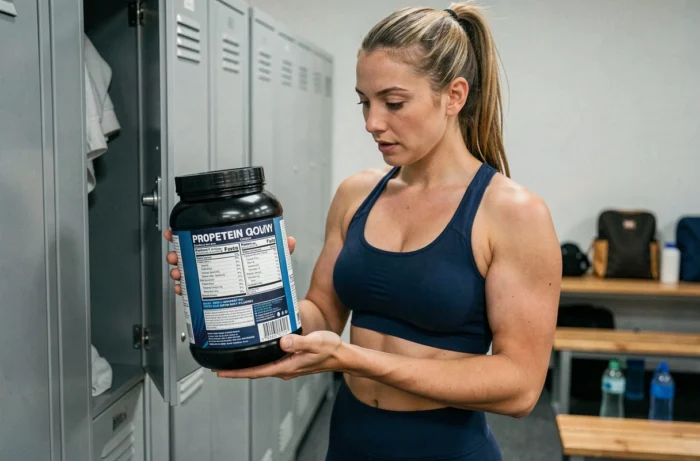
To identify the best protein powder for muscle gain, one must read the amino acid profile on the label or product sheet. A complete amino acid profile, detailing each amino acid per 100 g of product, allows you to check if the powder provides sufficient leucine and BCAAs per serving.
- Ensure that the amino acid profile is published in full and not summarized to a few amino acids selected by the brand.
- Compare the leucine content per serving (not per 100 g) among several products to neutralize differences in recommended dosages.
- Ensure that all important amino acids are present, as the absence of just one can limit muscle anabolism.
Whey, Casein, or Plant Protein: Comparative Table for Muscle Gain
Recent studies nuance the classic opposition between animal and plant proteins. A meta-analysis showed that animal proteins only perform slightly better than plant proteins for muscle gain, with a minimal effect size and a low level of evidence. Another study found no significant difference in muscle gain over several weeks, provided total protein and leucine intake were equalized.
| Type of Protein | Absorption Rate | Leucine Profile | Suitable Use for Muscle Gain |
|---|---|---|---|
| Concentrated Whey | Fast | High | Post-workout, quick snack |
| Isolate Whey | Fast | High, better purity | Post-workout, lactose intolerance |
| Casein | Slow (several hours) | Moderate to high | Before bed, between meals |
| Plant Protein (pea/rice blend) | Medium | Variable depending on the blend | Complete alternative if leucine is sufficient |
The determining point clearly emerges from the table: the absorption rate dictates the timing of intake, not the superiority of one type over another. Whey remains the reference post-workout due to its rapid absorption. Casein takes over during long periods without meals. Plant blends, when combining pea and rice to complete the amino acid spectrum, produce comparable results in muscle gain.
Protein Powder and Gainer: Two Different Approaches to Muscle Gain
The gainer mixes proteins and carbohydrates in varying proportions. It targets profiles that struggle to achieve a sufficient caloric surplus through diet alone. In contrast, a classic protein powder (whey, casein, plant) provides a concentrated protein intake without excess carbohydrates or fats.
For a practitioner whose diet already meets caloric needs, the gainer adds superfluous calories that are stored as fat rather than muscle. The protein powder alone allows for targeting amino acid intake without disrupting the energy balance.
Conversely, for a person with a fast metabolism who cannot eat enough, the gainer simplifies caloric intake. The choice between gainer and protein powder thus depends on individual dietary balance, not on an intrinsic superiority of one over the other.
Manufacturing Quality: Filtration, Additives, and Real Purity
The filtration method directly influences the purity of the powder and its actual protein content. Cold microfiltration preserves intact protein fractions, while hot processes or ion exchange can denature certain proteins and eliminate bioactive components.
- Prefer powders with a short ingredient list: protein, flavoring, possibly a sweetener. Each additional additive (thickeners, colorings) dilutes the actual protein content per serving.
- Check if the brand publishes independent laboratory analyses confirming the stated protein content. Some powders display inflated rates due to the addition of cheap free amino acids (amino spiking).
- A transparent label with a complete amino acid profile and third-party analyses is the best indicator of quality, ahead of price or packaging.
The rise of the consumer market has multiplied references in supermarkets and online, but not all products meet the same manufacturing standards. A low price often signals basic filtration or a high filling rate with maltodextrin.
Choosing a protein powder for muscle gain boils down to three concrete checks: a rich amino acid profile in leucine and important amino acids, a type of protein suitable for the time of consumption, and manufacturing transparency that can be verified. These three filters eliminate the majority of products that rely more on marketing than on actual composition.