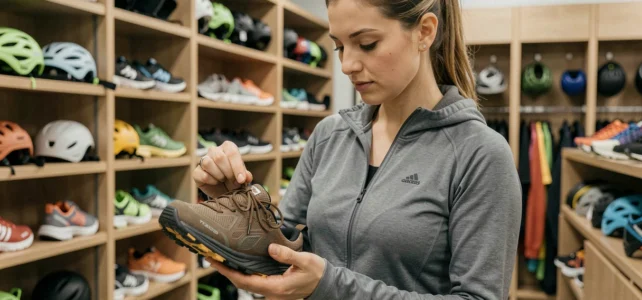
A poorly sized or non-compliant sports equipment does not provide protection, even if it seems to do so. Choosing sports gear with safety in mind relies on specific technical criteria, often overlooked in consumer guides: regulatory compliance, morphological fit, and the lifespan of protective components.
PPE Standards and CE Marking: What Regulations Really Require
All personal protective equipment sold in Europe must comply with the EU Regulation 2016/425 concerning PPE. This text classifies equipment into three risk categories. A bicycle helmet falls under category II (intermediate risks), while a climbing harness or a speed bike helmet falls into category III (serious or even fatal risks).
The CE marking is not an optional quality label. It certifies that the manufacturer has submitted the product to a notified body for compliance verification. The absence of this marking on shin guards, helmets, or elbow pads should be a reason for immediate elimination during purchase.
We still observe too many practitioners relying on price or aesthetics without checking for the specific standard applicable to their sport. For running, the standard focuses on cushioning and stability of the sole. For bicycle helmets, the reference standard is EN 1078, which includes requirements for cranial coverage and shock absorption.
We recommend consulting sports equipment on Profil Sport to quickly identify certified gear corresponding to each discipline.
Bicycle Helmet and E-Bikes: Why the EN 1078 Standard is No Longer Enough
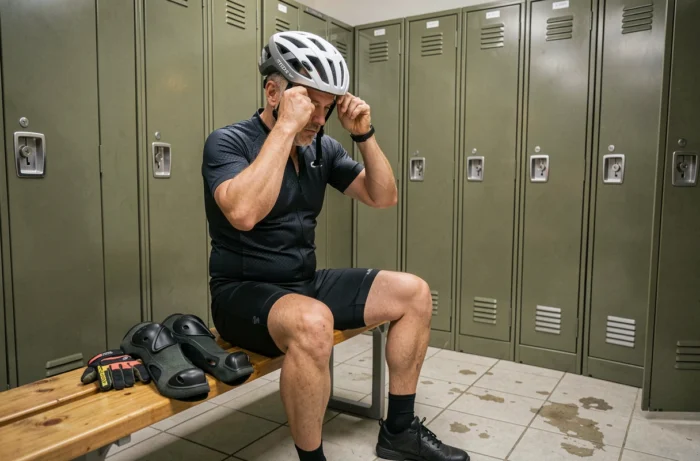
The EN 1078 standard, designed for moderate-speed impacts, covers most urban and road bicycle helmets. On a fast e-bike (capable of assisting up to 45 km/h), this standard has known limitations: insufficient coverage of the temples and the back of the head, and failure to account for oblique impacts.
Experts in soft mobility now recommend the NTA 8776 standard, developed in the Netherlands, which requires an expanded protection zone and resistance to more violent impacts. This is the reference for speed bikes and fast e-bikes.
Additionally, there is the anti-rotation technology MIPS (Multi-directional Impact Protection System). A real impact is rarely perpendicular: the head undergoes a rotation that can cause diffuse brain injuries. The MIPS system integrates a movable internal layer that reduces rotational forces transmitted to the brain.
In practice, a cyclist on a fast e-bike wearing a standard EN 1078 helmet without MIPS accepts a significantly higher level of risk than a user equipped with NTA 8776 + MIPS. The additional cost is real, but the difference in protection in the event of an oblique impact is documented by industry feedback.
Morphological Fit: The Criterion That Product Sheets Do Not Address
Equipment that complies with all standards loses much of its effectiveness if it is poorly fitted. We observe this in three categories of equipment in particular:
- Running shoes: an unsuitable model for the type of stride (pronated, supinated, universal) causes repeated joint stress on the knee and ankle, well before acute injury. The choice requires a stride analysis, not just the shoe size.
- Helmets: a helmet that moves laterally more than one centimeter when fully tightened will not protect in the event of an impact. The straps should form a Y under each ear, and the occipital dial should secure the helmet without pressure points.
- Joint protections (knee pads, elbow pads, back protectors): a protection that is too loose slips at the moment of impact, while a protection that is too tight limits the range of motion and prompts the user to remove it. The correct fit should be verified in motion, not in a static position.
Lifespan and Monitoring of Sports Protective Equipment
Each PPE has a defined lifespan set by the manufacturer, regardless of its apparent visual condition. A bicycle helmet that has sustained an impact, even without visible cracks, must be replaced: the expanded polystyrene structure deforms irreversibly upon the first significant compression.
For textile protective equipment (MTB back protectors, equestrian vests), the aging of foams reduces absorption capacity after a few seasons of intensive use. UV rays, humidity, and temperature variations accelerate the degradation of polymers.
We recommend implementing a monitoring register, especially for associations or clubs. This register records the purchase date, the date of first use, visual inspections performed, and impacts sustained. This is indeed a requirement for category III PPE in the context of establishments open to the public.
Checkpoints Before Each Use
- Check the integrity of the shell and internal foam (helmets, rigid protections).
- Inspect the condition of straps, buckles, and fastening systems: a cracked clip renders the protection ineffective.
- Ensure that reflective or signaling elements are still functional, especially for road use or in low-light conditions.
- Confirm that the size still fits the user, particularly for growing children and adolescents.
Sports equipment is not a one-time choice. Normative compliance, precise fitting, and rigorous monitoring form a triptych where no element is negotiable. Replacing a helmet after an impact, checking running shoes after a few hundred kilometers, inspecting protections before each outing: these technical gestures directly condition the actual level of safety for the practitioner.