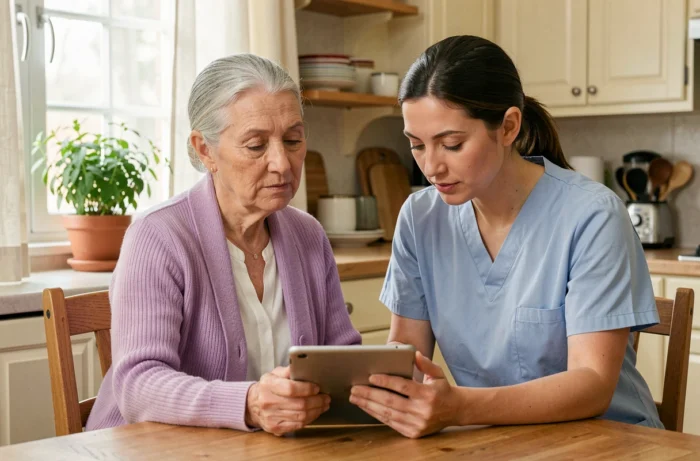
After 65, a woman can expect to live about 23.6 more years, but only 11.8 years without disability. For men, the ratio is comparable: 19.9 years of life expectancy, of which 10.5 years are without functional limitations. These data from the DREES Studies and Results bulletin No. 1363 present a clear finding: the quality of life for seniors is no longer progressing at the same pace as their longevity. Services aimed at the elderly must deal with this growing gap between years lived and years lived in good health.
Life expectancy without disability: a plateau that changes the game for seniors
Most support systems for the elderly have been designed with a focus on maintaining them at home, based on the idea that increased lifespan would naturally come with improved functional health. Recent figures contradict this assumption.
Since 2019, life expectancy without disability at 65 has stagnated: the gain is limited to four months for women and one month for men over five years. Over the period from 2008 to 2024, the cumulative progress reaches about one year and nine months, which remains modest compared to the increase in total life expectancy.
This plateau means that seniors are living longer with limitations. Adapted services can no longer simply respond to the loss of autonomy once it has occurred. Professionals who intervene at home or in facilities must integrate a preventive dimension, focused on early functional limitations (reduced mobility, balance disorders, mild cognitive difficulties). Platforms like ideosenior.fr help identify available services based on the profile and specific needs of each elderly person.
Social isolation of the elderly: the figures of rapid degradation
Isolation is a well-documented aggravating factor for loss of autonomy. Recent data show a concerning trend.
Between 2017 and 2025, the number of elderly people described as “cut off from almost all contact” (family, friends, neighbors, associations) has significantly increased. The increase in isolation primarily affects those over 80, a population for which regular social interactions play a protective role for cognitive and physical health.
Home care services cover material needs (shopping, meals, housing maintenance), but their intervention format, often limited to short time slots, does not compensate for the break in social ties. In contrast, some collective initiatives produce more tangible results in this regard:
- Group prevention workshops (balance, memory, nutrition), led by trained professionals, create a regular social framework while acting on functional capacities
- Meal delivery, when it includes a time for exchange with the recipient beyond simple delivery, reduces the feeling of daily isolation
- Next-generation teleassistance, which includes scheduled friendly calls and not just alerts in case of a fall, meets both relational and safety needs
Field feedback varies on the actual effectiveness of these approaches depending on the regions. In rural areas, the low density of professionals and geographical distance limit access to these collective services.
Housing adaptation and fall prevention: beyond construction work
Home modification remains a central lever for maintaining autonomy. The MaPrimeAdapt’ scheme, which finances part of the adaptation work (grab bars, walk-in showers, widening doors), has structured the offer since its implementation.
Fall prevention is not limited to the installation of equipment. A poorly positioned grab bar or an unsuitable floor covering can create a false sense of security. The ergonomic evaluation of the home, carried out by a professional who observes the actual movements of the person in their environment, produces more relevant recommendations than a standard diagnosis.
Three elements condition the effectiveness of housing adaptation:
- Anticipation: starting work before a fall occurs, not after hospitalization, reduces the risk of sudden loss of autonomy
- Human support: an adapted home without regular home care is insufficient if the person has balance disorders or cognitive difficulties
- Ongoing monitoring: needs evolve, and a relevant adaptation at 75 may become insufficient at 82, which requires periodic reassessments
The specific case of tenants
Homeowners have easier access to adaptation work aid. Tenants, on the other hand, depend on the landlord’s agreement to modify the home. This asymmetry hinders the adaptation of the rental stock, while a significant portion of low-income seniors are tenants. The landlord’s agreement remains a concrete obstacle for elderly tenants who wish to secure their homes.
Quality of care in nursing homes: new indicators under surveillance
For those for whom home care is no longer possible, the quality of support in facilities directly determines quality of life. Recently, nursing homes must report new quality indicators to the CNSA, focusing on concrete dimensions of residents’ daily lives.
These indicators measure tangible aspects of care, not just staffing ratios or administrative data. The Council of Europe has also made recommendations regarding the resources allocated to facilities, echoed by professional federations such as AD-PA.
The available data do not yet allow for conclusions about the real impact of these new indicators on residents’ experiences. Their publication is recent, and the first feedback from facilities is heterogeneous. Increased transparency is a lever, provided that families and professionals use it to guide support choices.
The quality of life for seniors depends less on a single system than on the interplay between early prevention, adaptation of the living environment, and maintenance of social ties. The main challenge remains to bridge the gap between years of life gained and years of life in good health, an objective that current public policies struggle to achieve.