
Fixing a rafter to a concrete block wall seems like the kind of job that looks simple on paper. You drill, you screw, and it’s done. Except that the hollow concrete block doesn’t offer the same resistance as a solid concrete block, and a poorly chosen fastening will eventually give way under the weight of the roof or pergola.
The choice of anchoring and the preparation of the support make all the difference between a rafter securely fastened and one that pulls away a few months later.
Why hollow concrete blocks complicate rafter fastening
The classic concrete block (hollow concrete block) consists of thin walls separated by empty cells. When you drill, the bit goes through a wall of a few centimeters and then falls into the void. A standard nylon expansion plug has almost nothing to hold onto.
This is where many DIYers go wrong. They use a standard mechanical plug, tighten it hard, and the fastening seems to hold. But as soon as the rafter experiences shear force (the weight of the frame pulling down) combined with pull-out force (the wind lifting the roof), the wall of the block bursts.
The right approach is to master the techniques of fixing rafters to concrete blocks while taking into account the hollow nature of the material. Two reliable solutions exist: chemical anchoring with a sleeve, and next-generation concrete screws.
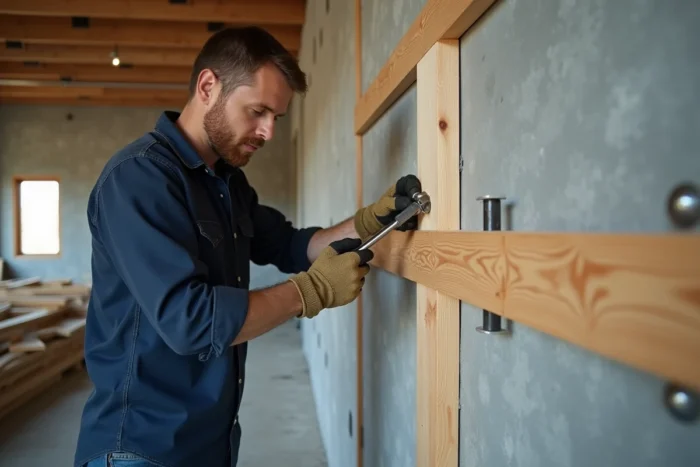
Chemical anchoring with a sleeve: the most reliable method on hollow concrete blocks
Chemical anchoring works on a simple principle. You insert a plastic sleeve (a perforated sleeve) into the drilled hole, then inject a resin that expands through the sleeve and forms a solid mass inside the cell of the concrete block. The threaded rod is then pushed into the resin before it cures.
Why the sleeve changes everything
Without a sleeve, the resin flows into the cell and gets lost at the bottom of the block. The sleeve holds the resin around the rod and creates a volumetric anchor. The sleeve transforms a hollow concrete block into a solid anchoring point.
The resins from major manufacturers (Hilti, Fischer, Spit) offer documented performance on hollow concrete blocks. But these values drop drastically if the hole cleaning protocol is not followed.
The dust removal protocol that conditions the hold
Manufacturer data shows a loss of strength of about 30 to 50% in the case of poorly cleaned drilling. A hole full of dust prevents the resin from adhering to the walls of the concrete block.
Here is the sequence that must be strictly followed:
- Blow out the hole with a bulb or blower after drilling to remove coarse debris
- Brush the inside of the hole with a suitable brush for the diameter, which removes the fine dust stuck to the walls
- Blow a second time to expel the dust dislodged by brushing
- Repeat the brushing-blowing operation if the support is very crumbly or old
Skipping any of these steps halves the final strength. This is the detail most often overlooked, yet the most decisive.
Concrete screws without plugs: a quick alternative on solid or reinforced concrete blocks
For a few years now, specific-thread concrete screws have allowed for direct fixing of a sill plate or rafter to a masonry support, without a plug. These screws (sometimes called direct-fix screws) are screwed into a pre-drilled hole and cut their own thread in the material.
This technique only works if the concrete block is solid or if the screw passes through the wall to reach a load-bearing area. On a standard hollow block, without reinforcement behind, the screw does not have enough material to anchor properly.
Anchoring depth to respect
For the concrete screw to hold, the anchoring depth in the load-bearing area must represent four to five times the diameter of the screw. With an 8 mm screw, an anchoring of at least 32 to 40 mm in solid concrete is required. If the wall of the concrete block is less than that, chemical anchoring remains preferable.
Fixing rafters in concrete reinforcements rather than in concrete blocks
You may have noticed those reinforced concrete bands running along the tops of concrete block walls, at the level of the floor or above openings? These are the horizontal reinforcements and lintels. They form homogeneous areas, much more resistant than an isolated hollow concrete block.
Fixing your rafters or sill plate in a concrete reinforcement rather than in a hollow concrete block multiplies the resistance to combined pull-out and shear forces. This area accepts both concrete screws and chemical anchoring, with significantly superior performance.
In practice, this means that you may need to adjust the height of the sill plate so that it aligns with the reinforcement. A few centimeters of offset are enough to transition from a fragile anchor to a solid anchor.
Common mistakes that weaken the anchoring on concrete blocks
Even with the right type of fastening, certain mistakes frequently occur on construction sites:
- Drilling in percussion mode on a hollow concrete block, which causes the wall around the hole to burst and reduces the gripping surface of the plug or resin
- Using metal expansion plugs in a hollow block, which exerts a spreading pressure on walls that are too thin to support it
- Not placing a sill plate between the wall and the rafters, which concentrates the forces on a single point instead of distributing them along the entire length of the wall
- Undersizing the diameter of the threaded rod relative to the section of the rafter and the expected roof loads
Drilling in rotation-only mode (without percussion) preserves the integrity of the concrete block and ensures a clean hole with intact walls. Use a diamond bit or a standard concrete bit without activating the hammer function of the drill.
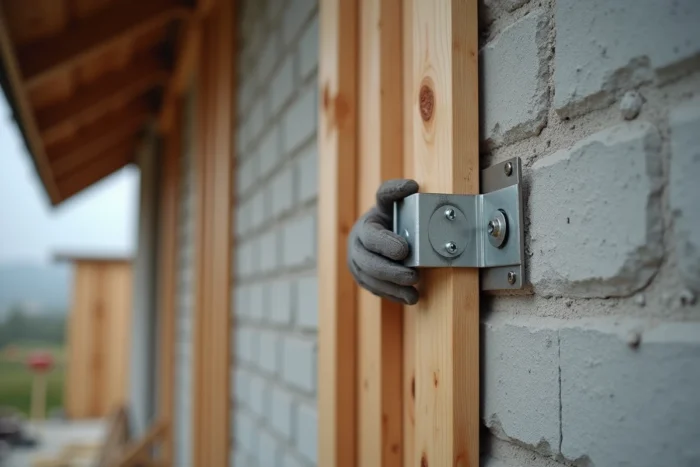
The treated wood sill plate, fixed to the wall first, then serves as a continuous support for the rafters. It distributes the loads and simplifies alignment. The rafters are then fixed to the sill plate with metal brackets or angles, which shifts the problem of masonry anchoring to a wood-metal assembly that is much more tolerant.
The choice between chemical anchoring and concrete screws directly depends on the type of concrete block and the location on the wall. An isolated hollow concrete block calls for chemical anchoring with a sleeve. A concrete reinforcement or a solid concrete block accepts direct concrete screws. In both cases, cleaning the hole remains the step that separates a durable fastening from a premature pull-out.