
Getting out of the trunk with a baby nestled on your hip, a diaper bag slipping off your shoulder, and a stroller that refuses to cooperate: we all know this scene. The folding and unfolding of a stroller determine the ease of every movement, much more than the design or color of the fabric. A few well-established gestures can radically change the daily experience.
Folding Mechanism: Understand What’s Blocking Before Forcing
The majority of blockages come from a safety lock that hasn’t been disengaged properly. On recent models, the EN 1888 standard requires anti-pinch systems and reinforced folding locks to prevent any accidental folding. The clear click heard when unfolding confirms that the chassis is locked in the open position.
Before pulling or pushing anything, identify the two elements to be activated: the release button (often on the handlebar or footrest) and the secondary pull tab or pedal. As long as these two points are not released simultaneously, the chassis will resist, and that’s normal.
Some strollers add a side latch that keeps the seat in place. Forgetting this gives the impression that the mechanism is stuck, when in fact, you just need to flip this latch before initiating the movement. Detailed explanations can be found on the Bébé Tout Neuf website for Trottine models, but the principle remains the same across most brands.
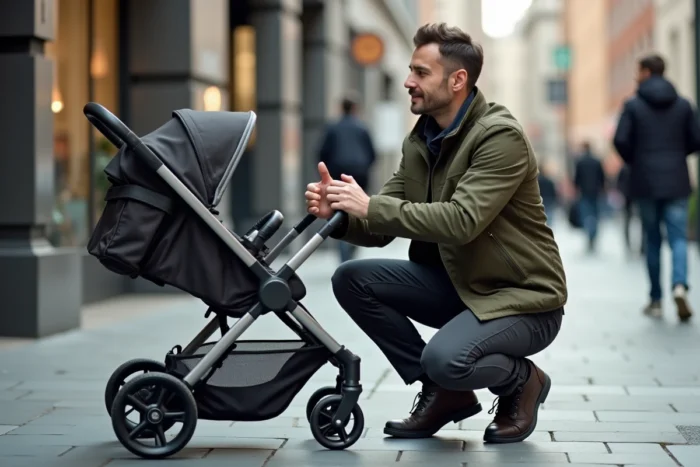
One-Handed Stroller Folding: The Technique That Changes Everything
Comparisons for 2025-2026 have established one-handed folding, baby in arms, as a priority selection criterion. This is not a marketing argument: it’s the real situation we find ourselves in several times a day.
To achieve this without struggling, the sequence is as important as the strength:
- Engage the parking brake to stabilize the stroller during manipulation. Without the brake, the chassis rolls when you press, making the action risky.
- Activate the release button with your thumb or the palm of your free hand, then guide the folding movement downwards without letting go of the handlebar.
- Check that the folded position lock engages (a second click or a sliding clip). A stroller that is not properly locked in the folded position will unfold in the trunk at the first turn.
The action becomes fluid after about ten repetitions without a child and without stress. It is recommended to practice at home before the first real outing.
Umbrella Stroller or Compact Stroller: The Folding Differs
On an umbrella stroller, the folding is longitudinal: the chassis folds like an umbrella. You pull the central handle upwards while pressing the pedal on the ground. The result is long and narrow, suitable for tight hallways but sometimes unstable once set down.
On a compact stroller, the folding is three-dimensional: the seat tilts forward and the wheels fold under the chassis. The final volume is reduced, and the stroller stands upright on its own once folded. This stability in the folded position prevents it from being propped against a wall or tipping over in an entryway.
Quick Unfolding of Stroller: Mistakes That Waste Time
Unfolding seems simpler than folding, but this is where we damage the mechanism through haste. The first mistake: shaking the stroller to force it open instead of activating the release. The hinges endure lateral stresses for which they are not designed.
The second mistake: not checking that the seat is properly clipped after unfolding. On several models, the seat can slightly detach during transport. Placing the child without reconfirming the seat lock exposes you to tipping.
Always test the stability of the chassis with a firm push on the handlebar before placing the child inside. If the chassis moves or creaks, a lock hasn’t clicked.
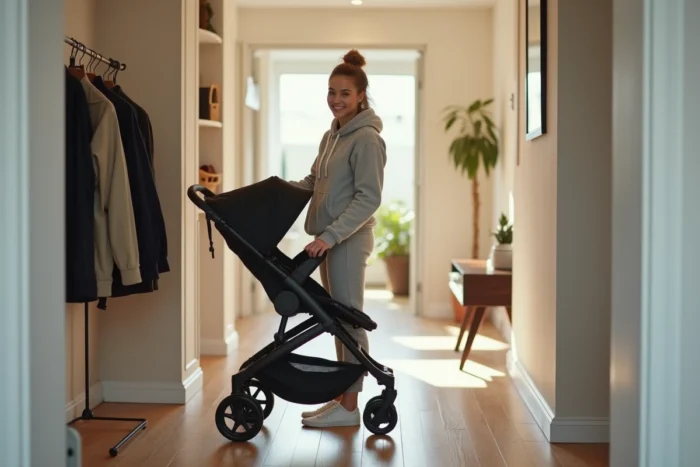
Maintaining the Folding Mechanism for Smooth Operation
A folding mechanism that becomes stiff after a few months rarely indicates a malfunction. Sand, crumbs, and dust accumulate in the joints and seize the hinges. A quarterly cleaning of the pivot points with a damp cloth is enough to restore original flexibility.
For lubrication, a drop of silicone lubricant on each hinge works well. It’s best to avoid classic WD-40, which attracts dust and ultimately worsens the problem. Feedback on this point varies by brand, but silicone remains the safest choice for plastic and aluminum parts.
- Check the clips and locking latches every two months. A worn clip no longer produces a firm click and compromises the safety of the fold.
- Inspect the swivel wheels before unfolding if the stroller has traveled in the hold or in a loaded trunk. A bent axle misaligns the chassis upon opening.
- Store the stroller folded in a dry place. Prolonged moisture oxidizes the rivets of the hinges, even on corrosion-treated models.
A well-maintained folding mechanism remains smooth throughout the stroller’s use. Cleaning the hinges takes less than five minutes and avoids the daily frustration of a stubborn chassis. When the folding action becomes automatic and the mechanism responds without resistance, the stroller becomes what it should always be: a transparent tool, serving the outing and not an additional obstacle in the way.