You have modeled your first characters in Blender, animated a few short scenes, and perhaps even produced a mini short film. The time to apply to a specialized school is approaching, and the admission file is where all the pressure lies. What makes the difference is not the volume of work presented, but how each piece of the file demonstrates an ability to progress in a production pipeline.
3D Animation Portfolio: What the Jurors Really Evaluate
Most admission guides emphasize the need for a portfolio. Few explain how a jury reads it. An educational recruiter is not looking for technical perfection. They seek a readable artistic intention in each project.
In concrete terms, a character modeled with awkward proportions but accompanied by preparatory sketches (silhouette research, expression studies) weighs more than a photorealistic render downloaded from a tutorial. The jury immediately spots an exercise reproduced exactly from a YouTube video.
Before assembling your portfolio, select three to five projects that showcase different stages of the 3D pipeline: modeling, texturing, lighting, walk cycle animation. If you are applying for a 3D animation and special effects training, demonstrating that you understand how these stages connect is more important than isolated mastery of a software.
- Include at least one personal project (not a class exercise) with a statement of intent of two or three sentences explaining your visual approach.
- Add images of your work process: wireframes, separate render passes, screenshots of your scene before and after corrections.
- If you have worked in a team (game jam, collective school project), clearly specify your exact role in the production.
A portfolio of five well-contextualized pieces is worth more than a gallery of twenty images without explanation.
Cover Letter and Admission Interview: Proving Your Visual Culture
The cover letter is still required by the majority of animation schools in France. Its classic pitfall: piling on superlatives about your passion for animated cinema without ever mentioning a specific film, studio, or technique.
Why does this detail matter so much? Because the jury seeks to measure your visual culture and analytical ability. Writing “I admire the special effects of such a film” without explaining what technically struck you (compositing, matte painting, fluid simulation work) remains an empty statement.
Structuring Your Letter Around a Central Theme
Choose a personal project or a discovery that sparked your desire to work in this field. Tell it in three paragraphs: the trigger, what you learned by trying to reproduce or understand this technique, and what the targeted training would bring you to go further.
Avoid listing the software you are proficient in within the letter. This information is already in the CV or portfolio. The letter serves to show how you think, not what you can do.
Preparing for the Oral Interview
Several schools complement the file with an interview. Questions rarely focus on your raw technical skills. You will be asked to explain an artistic choice in your portfolio or to comment on a projected image.
Practice describing an image in terms of composition, color palette, and visual storytelling. Being able to verbalize what you see distinguishes a curious candidate from a passive one.
Drawing and Artistic Foundations: The Often Underestimated Base
Have you never taken academic drawing classes? It’s not disqualifying, but it’s a point that the file must compensate for. 3D animation and VFX schools that offer a preparatory artistic year (often called “entertainment prep” or “leveling up”) operate on the premise that drawing can be developed. They want to see potential, not a finished level.
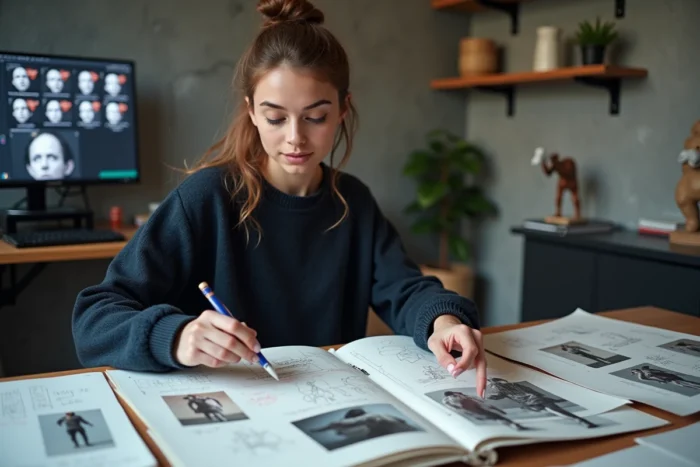
Add a few pages of sketchbook to your file: observational studies (everyday objects, quick character poses, urban perspectives). Observational drawing proves that you know how to look before modeling. This is precisely the skill that trainers seek to detect in a high school level candidate.
If your drawings are still hesitant, accompany them with a short note explaining your progression process. A jury forgives a clumsy line, but not a total absence of graphic practice.

Atypical Profiles and Career Changes: Highlighting Your Journey in the File
Candidates coming from another field (graphic design, video editing, web development, or even a profession unrelated to imagery) have an advantage that high school graduates do not: transferable professional experience.
Since the reform of the VAE and the establishment of the France VAE portal in 2024, the requirement for a minimum of one year of experience has been removed to initiate a validation of acquired skills for a title registered in the RNCP. For an admission file, this means that a self-taught individual who has produced 3D projects (short films, assets for video games, personal animations) can have part of their skills recognized even before entering training.
Mentioning this strategy in your cover letter or during the interview shows the jury that you have thought about your journey in a structured way. You are not simply asking for a place in training; you are articulating a professional project.
- Identify the skills from your previous profession that apply to 3D production: project management, deadline awareness, collaborative work, mastery of digital tools.
- Present your personal 3D achievements as evidence of autonomy and motivation, even if their technical level remains modest.
- Research the RNCP title targeted by the school and check if it is eligible for CPF, knowing that a financial contribution of 102.23 euros per training has been applicable since 2025 for any mobilization of the Personal Training Account.
A convincing career change file does not minimize the previous journey. It explicitly connects it to the skills expected in the fields of animation and special effects.
The admission file is not a beauty contest of graphics. It is a communication exercise: showing who you are as a creator, where you are in your learning, and why this specific training fits into a coherent trajectory. The juries receive hundreds of applications. Those that remain memorable are the ones where each piece of the file tells the same story, from the first sketch to the last line of the letter.