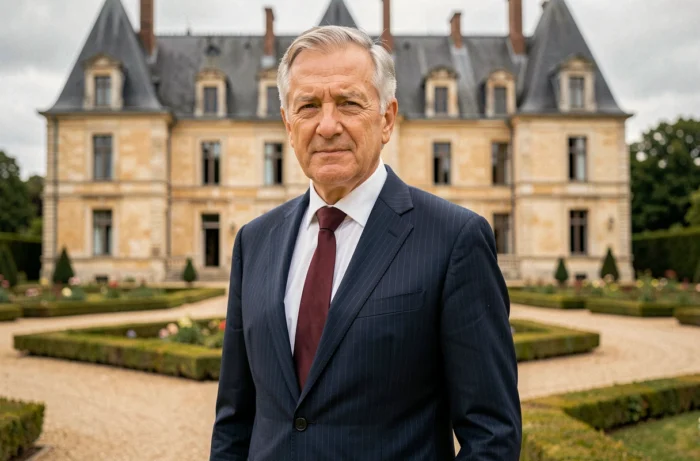
When trying to assess the wealth of Philippe de Villiers, one quickly encounters contradictory figures. Some estimates hover around 33 million euros, while others exceed 100 million. The discrepancy is largely explained by the confusion between what Villiers owns personally and what belongs to associative structures or companies that he does not directly own.
Puy du Fou: an empire that Philippe de Villiers does not own outright
The common reflex is to add the value of Puy du Fou to the personal wealth of its founder. The park generates considerable annual revenue, and one can understand the temptation to lump everything together. The problem is that the legal reality does not work that way.
Puy du Fou is operated by a SAS controlled by two associations: La Cinéscénie and Puy du Fou Stratégie. These associative entities hold the operating company of the park. Philippe de Villiers does not own it outright, which radically changes the wealth calculation.
One can discover Philippe de Villiers’ fortune from different angles, but this distinction between operational control and capital ownership remains the starting point for understanding why estimates vary so widely.
In practice, Villiers retains a power of influence and enjoyment over the entire group without the total value of the park appearing on his personal balance sheet. This is a classic arrangement in the French associative world, but applied on a scale rarely seen for a project of this magnitude.

ISF and IFI: how the status of professional assets protected Villiers’ wealth
Philippe de Villiers would never have paid the ISF. This claim, echoed by several journalistic investigations, is based on a specific tax mechanism: the status of professional assets. The assets related to the activity of Puy du Fou were classified as tools of work, thus excluded from the wealth tax base.
The transition from ISF to IFI in 2018 reduced the taxable scope to net real estate assets only. For a man whose main assets are linked to a theme park owned through associations, exposure to the IFI remains theoretically limited.
The new 2026 tax on enjoyment holdings
The 2026 finance law introduced a provision that could change the game. Article 235 ter C of the General Tax Code establishes an annual tax on the value of luxury and real estate assets held through certain holdings. The triggering conditions are as follows:
- Assets valued at 5 million euros or more
- Predominantly passive income within the structure
- Control exercised by an individual
This tax explicitly targets arrangements where enjoyment assets (residences, leisure properties) are housed in corporate structures without real operational activity. It is still unclear whether the Puy du Fou arrangement, which relies on cultural associations rather than a classic wealth-holding company, falls within the scope of this new legislation.
Family wealth and transmission: the Vendée strategy of the Villiers
The wealth of Philippe de Villiers is not limited to Puy du Fou. The family has deep roots in Vendée for generations, with real estate and land holdings whose valuation remains opaque. Several of his children hold positions within the park’s ecosystem or in related activities, suggesting a gradual transmission of operational control.
The model is based on a simple logic: to transfer decision-making power rather than market-valued shares. This approach minimizes inheritance taxes while maintaining family control over the whole.
What the estimates of 33 million euros actually include
When discussing a wealth of 33 million euros, it generally aggregates:
- Personal and family real estate in Vendée
- Accumulated income from the activity of Puy du Fou (estimated between 8 and 12 million euros per year according to some sources)
- Possible financial investments and copyright related to his works
Estimates exceeding 100 million euros likely include a share of the value of the Puy du Fou group itself, which amounts to attributing to Villiers an asset he does not legally own.
Declared wealth and actual wealth of Philippe de Villiers: why the gap persists
The difficulty with the wealth of French political figures lies in the absence of a detailed publication obligation outside of presidential election candidacies. Philippe de Villiers was a candidate in 2007, and his wealth declaration at that time obviously no longer reflects his current situation.
Since then, no legal obligation compels him to make his assets public. The figures circulating come from journalistic estimates, cadastral cross-checks, and analyses of corporate structures. Each source applies its own methodology, leading to considerable discrepancies.
The introduction of the tax on enjoyment holdings and the strengthening of IFI controls in 2026 could require greater transparency regarding complex wealth arrangements. For now, Philippe de Villiers’ verifiable personal wealth remains significantly lower than what the notoriety of Puy du Fou might suggest. The confusion between the man and the institution he created fuels a lasting misunderstanding of his real wealth.